

In the realm of microfluidics and analytical chemistry, the transition from a standard cylindrical quartz tube to a specialized square quartz capillary tube represents a significant leap in optical engineering. While round tubes are suitable for general fluid transport, they often introduce optical distortions that compromise the integrity of laser-based measurements. For researchers and engineers working on DNA sequencing or flow cytometry, the unique geometry of a square tube is not a design preference but a technical necessity.
But what makes the square quartz capillary tube so distinct in a market full of micro-glass components? To understand its value, we must examine the intersection of material science and geometric optics.
Geometric Precision and Optical Clarity
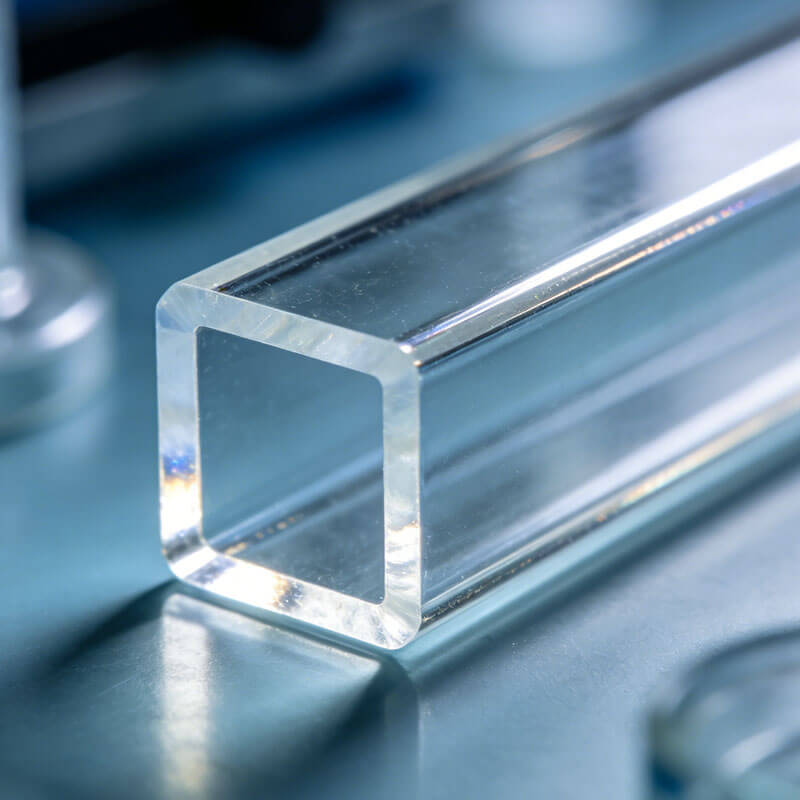
The primary advantage of a clear square tube lies in its flat parallel walls. When a laser beam passes through a standard round quartz tube, the curved surface acts as a lens, refracting the light and creating a “lensing effect” that scatters the signal. This scattering makes it difficult to achieve precise fluorescence detection or particle counting.
A square capillary tube eliminates this issue entirely. The flat interior and exterior surfaces allow light to pass through perpendicularly with minimal refraction. This structural feature is why the square quartz capillary tube is the gold standard for flow cells. It ensures that the excitation laser strikes the sample at a consistent angle, providing a clear, undistorted path for the resulting optical signal to reach the detectors.
Material Integrity of the Square Glass Capillary Tube
While the term square glass capillary tube is often used in general laboratory contexts, there is a profound difference between standard borosilicate glass and high-purity fused silica. A true square quartz capillary tube is manufactured from synthetic fused silica with an SiO_2 purity exceeding 99.9%.
This material choice provides several critical industrial advantages:
- UV Transparency: Unlike typical glass, quartz allows for deep ultraviolet transmission, which is vital for UV-induced fluorescence applications.
- Thermal Resilience: These tubes can withstand extreme temperature gradients without losing their structural dimensions, a common requirement in high-temperature chemical analysis.
- Chemical Inertness: The high purity of the square tube prevents ionic leaching, ensuring that the sample remains uncontaminated during sensitive electrophoresis processes.
| Feature | Standard Borosilicate Glass | High-Purity Fused Silica (Quartz) |
| SiO2 Purity | ~80% | > 99.9% |
| UV Transmission | Low (absorbs below 300nm) | High (excellent down to 170nm) |
| Max Service Temp | ~500°C | Up to 1100°C |
| Thermal Expansion | 33* 10^{-7}°C | 5.5 *10^{-7}°C |
Technical Fabrication and Tolerances
Manufacturing a square quartz capillary tube requires a sophisticated drawing process. Unlike standard extrusion, these micro-components are drawn from a precisely machined preform. The challenge lies in maintaining the “squareness” of the inner bore while keeping the wall thickness uniform.
Professional suppliers provide these tubes with internal dimensions ranging from 50 microns to several millimeters. The tolerances are often kept within +- 2% of the specified dimension. Such precision is what allows a square capillary tube to be integrated into automated medical diagnostic equipment where even a 5-micron deviation could lead to inaccurate fluid volume calculations.
| Parameter | Typical Range | Standard Tolerance |
| Inner Bore Size | 50μm – 2.0mm | +-2% to 5% |
| Wall Thickness | 100μm – 1.0mm | +- 10% |
| Surface Quality | Optical Grade | 40/20 Scratch-Dig |
Industry Applications and Sourcing
The decision to source a square quartz capillary tube over a round one is typically driven by the end-use environment. In capillary electrophoresis, the square interior helps in reducing the heat generated by the “Joule effect,” thereby maintaining the stability of the separation process. In laser-induced fluorescence (LIF), the clear square tube geometry is mandatory to minimize background noise and maximize the signal-to-noise ratio.
When evaluating quartz tube manufacturers for these specialized components, engineers should verify the surface quality (often measured in scratch-dig standards) and the hydroxyl (OH) content of the silica. Low-OH quartz is particularly important for applications involving near-infrared (NIR) spectroscopy to avoid absorption peaks that could interfere with data.
| Application | Core Requirement | Why Square Quartz? |
| DNA Sequencing | UV Transparency | Allows UV laser excitation without absorption. |
| Flow Cytometry | No Refraction | Flat walls prevent false-positive signals. |
| Chemical Reactors | Thermal Resistance | Withstands exothermic reactions without deforming. |
Final Technical Insights
The square quartz capillary tube is a masterclass in functional geometry. By combining the exceptional chemical and thermal properties of fused silica with a flat-wall design, it solves the optical challenges that have long plagued micro-bore fluidics.
Whether you are designing a high-throughput screening system or a custom laboratory setup, selecting a high-quality square glass capillary tube ensures that your optical path remains unobstructed and your fluid dynamics remain predictable. As the industry moves toward further miniaturization, the role of the square tube as a precision interface between light and liquid will only continue to grow.