

Fused quartz tubes — sometimes called fused silica tubes, the two terms refer to the same material — occupy a position in industrial thermal processing that no other material reliably fills. They perform where borosilicate glass fails, where ceramic alternatives introduce contamination risk, and where transparency at high temperature is not optional. Across semiconductor fabrication, industrial heating lines, and laboratory research, they are the default choice wherever extreme heat, chemical purity, and rapid thermal cycling converge. This article explains how to read their thermal limits accurately, how different grades behave under sustained heat, and what to look for when specifying dimensions and sourcing from a manufacturer.
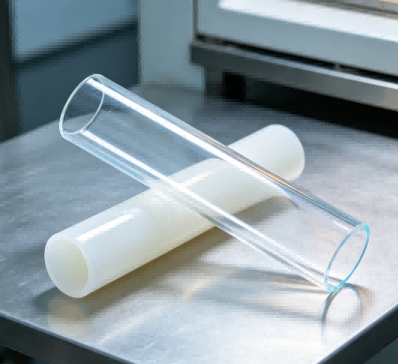
What Temperature Can a High Temperature Quartz Tube Actually Withstand
The answer depends on three things: the SiO₂ purity grade, whether the application involves continuous or intermittent heating, and the operating atmosphere around the tube.
Standard clear fused quartz tubes (≥99.9% SiO₂) maintain structural integrity at 1050–1100 °C under continuous thermal load. Short-duration peak exposure can approach 1150–1200 °C before meaningful deformation risk develops. Softening — the point at which the material begins to flow under its own weight — does not occur until approximately 1650 °C. For reference, borosilicate glass softens around 820 °C. That gap is why fused silica tubing is specified wherever sustained high-heat duty is required and borosilicate falls short.
The thermal property that most distinguishes fused silica from competing materials is its near-zero coefficient of thermal expansion — approximately 0.55 × 10⁻⁶ /°C. In practical terms, a quartz tube furnace can cycle from ambient temperature to 1000 °C and back within minutes without fracturing. The same cycle would destroy borosilicate glass. This is why quartz process tubes in semiconductor fabrication routinely survive hundreds of thermal cycles before replacement becomes necessary.
| Thermal Property | Value |
|---|---|
| Softening point | ~1650 °C |
| Annealing point | ~1150 °C |
| Continuous use limit (standard clear grade) | 1050–1100 °C |
| Thermal expansion coefficient | ~0.55 × 10⁻⁶ /°C |
| Thermal conductivity (at 20 °C) | ~1.4 W/m·K |
One degradation mechanism that operating engineers need to plan for is devitrification — the gradual crystallization of the amorphous silica surface that accelerates above approximately 1050–1100 °C. As devitrification progresses, the tube surface turns milky or opaque and mechanical strength decreases. Higher purity grades delay the onset of devitrification, which directly extends service life at sustained operating temperatures. The grades section below covers this in detail.
Where High Temperature Quartz Tubing Is Used
Fused quartz tubing appears across three distinct industrial environments, each with its own set of performance demands.
Semiconductor Diffusion and Oxidation Furnaces
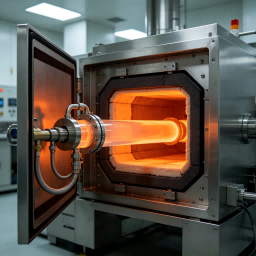
Silicon wafer fabrication — thermal oxidation, dopant diffusion, and post-implant annealing — runs at 800–1200 °C inside horizontal or vertical tube furnaces. The quartz tube defines the process atmosphere and holds the wafer boat in position throughout the thermal cycle. At these temperatures and at this proximity to the wafer surface, even trace metallic contamination migrating from the tube material degrades device yield. Semiconductor-grade fused silica tubes are therefore specified with total metallic impurity levels below 20 ppm, and below 5 ppm for the most sensitive process steps. Lot-level purity certification with ICP-MS trace element data is standard practice for this application.
Industrial Heating and Infrared Systems
Quartz tubes serve as protective sheaths for heating elements in industrial furnaces, infrared drying lines, and batch thermal processing equipment. In this context, opaque (milky white) quartz is frequently preferred over clear fused quartz: its translucent wall structure distributes radiated heat more evenly across the load, which matters in batch applications where heating uniformity is a process variable. At operating temperatures of 800–1000 °C, quartz-enclosed tungsten or FeCrAl heating coils achieve significantly longer service life than open-coil configurations, because the tube shields the element from oxidation.
Laboratory Reactors and Research Equipment
Combustion analysis, catalytic research, and materials testing setups use fused quartz reaction tubes for a combination of properties that no ceramic alternative provides: chemical inertness, thermal capability up to 1100 °C, and full optical transparency through the tube wall. A researcher can observe a reaction in progress at 900 °C through a transparent quartz reaction tube while maintaining a sealed controlled atmosphere. Alumina cannot offer this optical access, and borosilicate glass cannot survive the temperature.
Fused Quartz Tube Grades and How Purity Affects Thermal Performance
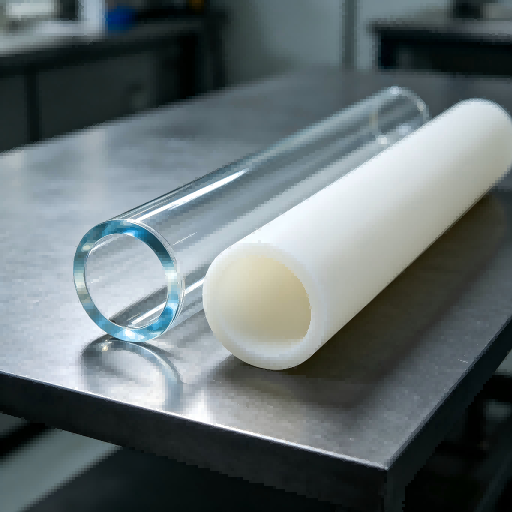
The term “quartz tube” covers a range of material grades with meaningfully different performance envelopes. Grade selection is driven by required purity level, operating temperature ceiling, and whether optical transparency is part of the application requirement.
| Grade | SiO₂ Purity | Continuous Use Limit | Devitrification Onset | Transparency | Typical Application |
|---|---|---|---|---|---|
| Standard Clear | ≥99.9% | 1050 °C | ~1050 °C | Full | Industrial heating sheaths, IR enclosures |
| High Purity Clear | ≥99.99% | 1100 °C | ~1100 °C | Full | Laboratory reactors, R&D furnaces |
| Semiconductor Grade (Synthetic) | ≥99.999% | 1100 °C | >1100 °C | Full | Semiconductor diffusion and oxidation furnaces |
| Opaque / Milky White | ≥99.9% | 1050 °C | ~1050 °C | None | Infrared heaters, batch processing lines |
Temperature figures are consistent with published datasheets from Heraeus and Momentive.
Two points of clarification that frequently come up when specifying fused silica tubing are worth addressing directly. First, on terminology: “fused quartz” and “fused silica” are used interchangeably across most industrial and laboratory contexts — both refer to amorphous silicon dioxide produced by melting high-purity SiO₂ feedstock. The distinction that carries practical weight is between natural and synthetic feedstock. Standard and high purity grades typically use natural crystalline quartz as the starting material, while semiconductor-grade tubes use synthetic SiO₂ produced by vapor-phase oxidation of silicon tetrachloride (SiCl₄). The synthetic route achieves the sub-ppm metal impurity levels that wafer fabrication requires.
Second, on service life: how long a quartz furnace tube lasts in service depends primarily on the operating temperature relative to the devitrification onset of the grade specified, and on the frequency and rate of thermal cycling. A semiconductor-grade tube operating at 1050 °C in a controlled oxidation atmosphere can survive several hundred to over a thousand thermal cycles before replacement. The same tube operated continuously at 1150 °C would devitrify within weeks. Grade selection is not only a purity decision — it is a service life decision with direct impact on maintenance interval and replacement cost.
Dimensional Specifications and What Differential Thermal Expansion Means in Practice
Standard clear fused quartz tubes are available across a wide dimensional range. The table below covers the standard sizes carried by most manufacturers and the tolerances achievable through precision tube drawing and CNC grinding:
| Parameter | Standard Range | Typical Tolerance |
|---|---|---|
| Outer diameter (OD) | 2–300 mm | ±0.05 mm |
| Wall thickness | 0.5–10 mm | ±0.03 mm |
| Length | Up to 3,000 mm | On request |
Custom dimensions beyond these ranges are available through direct manufacturer engagement.
One dimensional consideration that is often overlooked during specification is differential thermal expansion at the interface between the quartz tube and adjacent components. Fused silica’s expansion is nearly negligible — a tube with a room-temperature OD of 50 mm will measure essentially the same diameter at 1000 °C. The steel flanges or ceramic end fittings it connects to expand at substantially higher rates. Furnace designs must account for this differential through floating joints, compliant seals, or purpose-designed quartz flanges. The issue becomes most critical in applications that cycle frequently between ambient and operating temperature, where repeated differential movement can stress the interface points.
End finishing options — ground, fire-polished, flanged, or sealed — are determined by the furnace or reactor interface geometry. Fire-polished surfaces are generally preferred for continuous high-temperature applications: the smooth surface slows devitrification initiation relative to ground surfaces, reducing the rate at which crystallization propagates from surface defects. This translates directly into longer tube service life.
How to Evaluate a Quartz Tube Manufacturer
For general industrial heating applications, material grade and dimensional tolerance are the primary selection criteria. For semiconductor fabrication or any process where tube quality directly affects product yield, manufacturer capability matters equally to the material specification itself.
Material traceability is the starting point. Reputable manufacturers supply lot-level purity certification documenting SiO₂ content and trace element concentrations — aluminium, iron, sodium, potassium, calcium, and magnesium at minimum. For semiconductor applications, this certification is non-negotiable, and the measurement methodology (ICP-MS or equivalent) should match the detection limits required by the process specification.
Dimensional control across full tube length, not only at the ends, indicates the quality of the manufacturer’s tube drawing and grinding processes. Inconsistent wall thickness creates thermal hot spots under load — a failure mode that becomes critical in semiconductor process tubes where wafer-to-tube spacing is tightly controlled and temperature uniformity is a specification parameter.
Surface quality affects both contamination risk and service life. The inner surface of a process tube used in semiconductor fabrication must be free of inclusions and subsurface defects that could serve as contamination sources or mechanical failure initiation points under thermal stress. Fire-polished outer surfaces extend service life by reducing the surface energy at which devitrification nucleates.
Custom fabrication capability — closed-end configurations, flanged assemblies, multi-step diameter transitions, bends — matters for applications where standard straight tubes cannot meet the process geometry. Manufacturers with in-house CNC grinding, fire polishing, and sealing capability reduce the lead time and handling risk that come with multi-supplier fabrication chains. Tubes sourced directly from a specialized manufacturer typically ship with inspection reports covering dimensional verification, visual quality grading, and purity certification where applicable.
Conclusion
High temperature quartz tubes hold a specific and largely irreplaceable position in semiconductor manufacturing, industrial thermal processing, and laboratory research — wherever extreme heat, dimensional stability, chemical inertness, and thermal shock resistance must be met simultaneously. Getting the grade selection right, specifying dimensions with awareness of differential thermal expansion at interfaces, and sourcing from a manufacturer with documented quality control are the three decisions that most directly determine operating performance and tube service life.
For custom configurations — including non-standard diameters, closed-end geometries, or semiconductor-grade specifications — our engineering team is available to review technical requirements and advise on the appropriate grade and fabrication approach.
Have a technical question about fused quartz tube selection for your application? Contact our engineering team for application-specific guidance.