

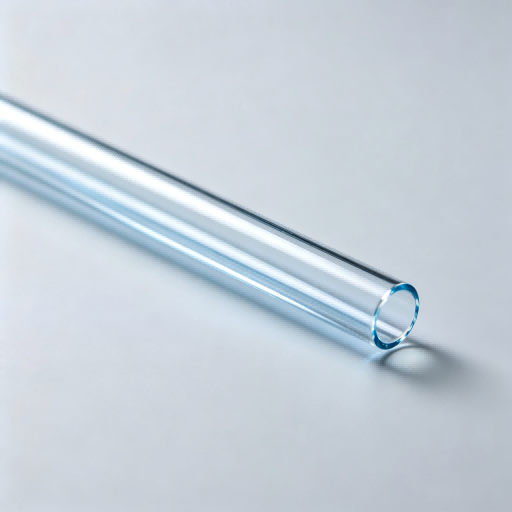
Fused quartz tubes, also known as fused silica tubes, are widely used in industrial thermal processing where high temperature resistance, chemical purity, and thermal stability are required. They perform in environments where borosilicate glass cannot provide sufficient heat resistance and where ceramic alternatives may introduce contamination concerns.
Across semiconductor fabrication, industrial heating systems, and laboratory research equipment, high temperature quartz tubes are selected for their ability to withstand extreme heat, rapid thermal cycling, and demanding process conditions.
However, selecting the right quartz tube requires more than simply checking the maximum temperature rating. The correct choice depends on several factors, including quartz purity grade, operating temperature, thermal cycling frequency, tube dimensions, and manufacturing quality.
What Temperature Can High Temperature Quartz Tubes Withstand?
The temperature capability of a high temperature quartz tube depends mainly on three factors:
- SiO₂ purity grade
- Continuous or intermittent heating conditions
- Operating atmosphere around the tube
Standard clear fused quartz tubes with ≥99.9% SiO₂ purity can typically maintain structural stability at 1050–1100°C under continuous thermal load. Short-term temperature exposure may reach 1150–1200°C, although prolonged operation at higher temperatures can accelerate material degradation.
The softening point of fused quartz is approximately 1650°C, which is significantly higher than borosilicate glass. This temperature difference is why fused silica tubing is widely used in applications requiring long-term high-temperature operation.
| Thermal Property | Typical Value | Why It Matters |
|---|---|---|
| Continuous operating temperature | 1050–1100°C | Determines long-term service capability |
| Short-term peak exposure | 1150–1200°C | Handles temporary temperature increases |
| Softening point | ~1650°C | Indicates deformation limit |
| Annealing point | ~1150°C | Important for stress relief |
| Thermal expansion coefficient | 0.55 × 10⁻⁶ /°C | Provides excellent thermal shock resistance |
| Thermal conductivity (20°C) | ~1.4 W/m·K | Influences heat transfer performance |
One of the most important advantages of fused quartz is its extremely low thermal expansion coefficient. This allows quartz tubes to withstand repeated heating and cooling cycles with a much lower risk of cracking compared with conventional glass materials.
For example, quartz furnace tubes used in semiconductor processing can experience hundreds of thermal cycles during service because the material maintains dimensional stability even under rapid temperature changes.
Another factor affecting long-term performance is devitrification.
Devitrification is the gradual crystallization of the amorphous silica structure. As this process progresses, the quartz surface may become cloudy or milky, while mechanical strength decreases. Higher purity quartz grades generally provide better resistance to devitrification and longer service life under sustained high-temperature operation.
Where Are High Temperature Quartz Tubes Used?
High temperature quartz tubing is used across industries where heat resistance, chemical stability, and process reliability are essential.
The main application areas include semiconductor manufacturing, industrial heating equipment, and laboratory thermal processing systems.
| Application | Typical Temperature Range | Why Quartz Tubes Are Used |
|---|---|---|
| Semiconductor diffusion and oxidation furnaces | 800–1200°C | High purity and low contamination risk |
| Industrial heating and infrared systems | 800–1000°C | Heating element protection and thermal stability |
| Laboratory reactors and research equipment | Up to 1100°C | Chemical resistance and optical transparency |
Semiconductor Diffusion and Oxidation Furnaces
Semiconductor manufacturing is one of the most demanding applications for fused quartz tubes.
Processes such as thermal oxidation, dopant diffusion, and post-implant annealing are typically performed at 800–1200°C inside horizontal or vertical tube furnaces. The quartz process tube maintains a controlled atmosphere while supporting wafer carriers throughout repeated thermal cycles.
Because quartz tubes are positioned close to semiconductor wafers, material purity is critical. Even trace metallic contamination can affect device performance and production yield.
For this reason, semiconductor-grade fused silica tubes are manufactured with extremely low impurity levels and are commonly supplied with purity certification and trace element analysis.
Industrial Heating and Infrared Systems
Quartz tubes are widely used as protective sleeves for heating elements in industrial furnaces, infrared heating systems, and thermal processing equipment.
In these applications, quartz tubes help protect heating coils from oxidation while maintaining efficient heat transfer.
Opaque or milky white quartz is often preferred for infrared heating systems because its translucent structure helps distribute radiant heat more evenly across the target area. This is particularly valuable in batch processing applications where temperature uniformity affects product quality.
At operating temperatures of approximately 800–1000°C, quartz-enclosed heating elements can achieve longer service life compared with exposed heating coils because the tube provides protection from oxidation and environmental contamination.
Laboratory Reactors and Research Equipment
Laboratory and research equipment often uses fused quartz reaction tubes because they provide a combination of properties that alternative materials cannot easily match:
- High temperature capability
- Chemical resistance
- Low contamination
- Optical transparency
Researchers can observe reactions through transparent quartz tubes while maintaining controlled high-temperature conditions.
Applications include:
- Combustion analysis
- Catalyst research
- Materials testing
- High-temperature chemical experiments
Fused Quartz Tube Grades and How Purity Affects Thermal Performance
The term quartz tube covers a range of material grades with different performance characteristics. The correct grade depends on the required temperature range, contamination sensitivity, and whether optical transparency is needed for the application.
Higher purity quartz generally provides better resistance to contamination and improved performance in demanding thermal environments. However, the highest purity grade is not always necessary. The best choice depends on the actual process requirements.
| Quartz Tube Grade | SiO₂ Purity | Continuous Use Limit | Transparency | Typical Applications |
|---|---|---|---|---|
| Standard Clear Quartz | ≥99.9% | Around 1050°C | Full | Industrial heating systems, furnace protection tubes |
| High Purity Clear Quartz | ≥99.99% | Around 1100°C | Full | Laboratory reactors, advanced thermal processing |
| Semiconductor Grade Quartz | ≥99.999% | Around 1100°C | Full | Semiconductor diffusion and oxidation furnaces |
| Opaque / Milky White Quartz | ≥99.9% | Around 1050°C | None | Infrared heaters, batch heating systems |
The terms fused quartz and fused silica are often used interchangeably in industrial and laboratory applications. Both refer to amorphous silicon dioxide (SiO₂) produced through a melting process.
The main difference that affects performance is the raw material source. Standard and high-purity quartz tubes are commonly produced from natural quartz feedstock, while semiconductor-grade tubes may use synthetic silica materials to achieve extremely low impurity levels.
For semiconductor processing, synthetic fused silica is preferred because it can meet the strict contamination control requirements of advanced wafer fabrication.
Service life is also closely related to grade selection. A quartz tube operating within its recommended temperature range can provide long-term reliability, while continuous operation beyond the suitable temperature range can accelerate devitrification and shorten replacement intervals.
What Specifications Should Be Considered When Ordering Quartz Tubes?
Choosing the correct quartz tube dimensions is essential for ensuring proper installation, stable heating performance, and long service life.
Important specifications include:
- Outer diameter (OD)
- Inner diameter (ID)
- Wall thickness
- Length
- Dimensional tolerance
- Surface finish
- End processing requirements
Standard clear fused quartz tubes are available in a wide range of dimensions, while custom sizes can be manufactured according to specific furnace or reactor designs.
| Parameter | Standard Range | Typical Consideration |
|---|---|---|
| Outer diameter (OD) | 2–300 mm | Must match equipment requirements |
| Wall thickness | 0.5–10 mm | Affects strength and heat transfer |
| Length | Up to 3000 mm | Depends on furnace chamber design |
| Dimensional tolerance | According to application requirements | Important for uniform heating and installation |
Why Thermal Expansion Should Be Considered in Quartz Tube Design
Although fused quartz has an extremely low thermal expansion coefficient, the surrounding components connected to the tube may expand much more during heating.
For example, metal flanges and ceramic fittings usually experience greater thermal expansion than quartz. If the connection design does not allow for this difference, repeated heating and cooling cycles may create stress at the interface points.
Proper designs often use:
- Flexible sealing structures
- Floating connections
- Quartz-compatible fittings
Considering thermal expansion during the design stage helps prevent premature failure and improves overall furnace reliability.
How Does Surface Finish Affect Quartz Tube Performance?
The surface finish of a quartz tube can influence both durability and service life.
Common finishing options include:
| Surface Finish | Characteristics | Typical Application |
|---|---|---|
| Fire polished | Smooth surface with fewer defects | Continuous high-temperature applications |
| Ground | Precision dimensional control | General industrial applications |
| Flanged | Easy equipment connection | Furnace and reactor systems |
| Sealed end | Custom process requirements | Specialized thermal systems |
Fire-polished surfaces are often preferred for demanding applications because smoother surfaces reduce the formation points where devitrification can begin.
What Should You Look for in a Quartz Tube Manufacturer?
Selecting the right manufacturer is just as important as selecting the correct quartz grade. For general industrial heating applications, material quality and dimensional accuracy are key considerations. For semiconductor and contamination-sensitive processes, manufacturing capability and quality control become equally important.
When evaluating a quartz tube supplier, consider the following factors:
| Evaluation Factor | Why It Matters |
|---|---|
| Material certification | Confirms SiO₂ purity and material consistency |
| Dimensional inspection | Ensures accurate OD, ID, and wall thickness |
| Surface quality control | Reduces defects and improves service life |
| Custom fabrication capability | Supports special tube designs and assemblies |
| Quality inspection records | Provides production traceability |
Material Traceability and Quality Control
A reliable quartz tube manufacturer should provide clear information about material quality, including:
- SiO₂ purity level
- Trace element analysis
- Production batch information
- Dimensional inspection results
For semiconductor applications, purity certification is especially important because elements such as aluminium, iron, sodium, potassium, calcium, and magnesium can affect process performance.
Custom Fabrication Capability
Many applications require more than standard straight quartz tubes. Depending on the equipment design, manufacturers may need to provide customized solutions, including:
- Custom diameters
- Closed-end tubes
- Flanged assemblies
- Multi-step diameter designs
- Precision grinding
- Fire polishing
Manufacturers with in-house processing capabilities can provide better consistency and reduce the risks associated with multiple supplier chains.
Selecting the Right Quartz Tube for Your Application
Choosing a high temperature quartz tube requires balancing temperature requirements, purity level, dimensions, and manufacturing quality.
Before selecting a quartz tube supplier, consider:
| Selection Factor | Key Question |
|---|---|
| Operating temperature | What is the actual continuous working temperature? |
| Thermal cycling | How frequently will the tube be heated and cooled? |
| Purity requirement | Does the process require strict contamination control? |
| Tube dimensions | What OD, ID, wall thickness, and length are required? |
| Custom requirements | Are special shapes or finishing options needed? |
High temperature quartz tubes provide reliable performance in semiconductor manufacturing, industrial furnace systems, and laboratory thermal processing when the correct grade and specifications are selected.
For custom quartz tube requirements, including non-standard dimensions, special end processing, or high-purity applications, our engineering team can help evaluate the suitable material grade and fabrication solution.
Contact us to discuss your quartz tube requirements and find the right solution for your thermal processing application.